The Gardener’s Lesson
A young gardener was hired to tend part of a large estate. Each morning, she watered the beds, pruned what needed pruning, pulled weeds, and watched for signs that the plants were struggling.
The head gardener did not follow behind her with a watering can. He did not pull every weed himself. He did not take over the work whenever rain was forecast or a plant began to wilt.
His responsibility was different. He made sure she understood the garden she had been given, had the tools and support she needed, and knew what healthy plants should look like. He checked in. He paid attention. When something was not working, he addressed it.
The young gardener was responsible for tending the plants and accountable for their health. The head gardener was responsible for holding her accountable and remained accountable for the estate.
That is the relationship between responsibility and accountability.
In organizations, the two words are often used as though they mean the same thing. They do not. When they are blurred, managers take on work that belongs to their people, employees wait to be told what to do, and nobody is entirely certain who owns the result.
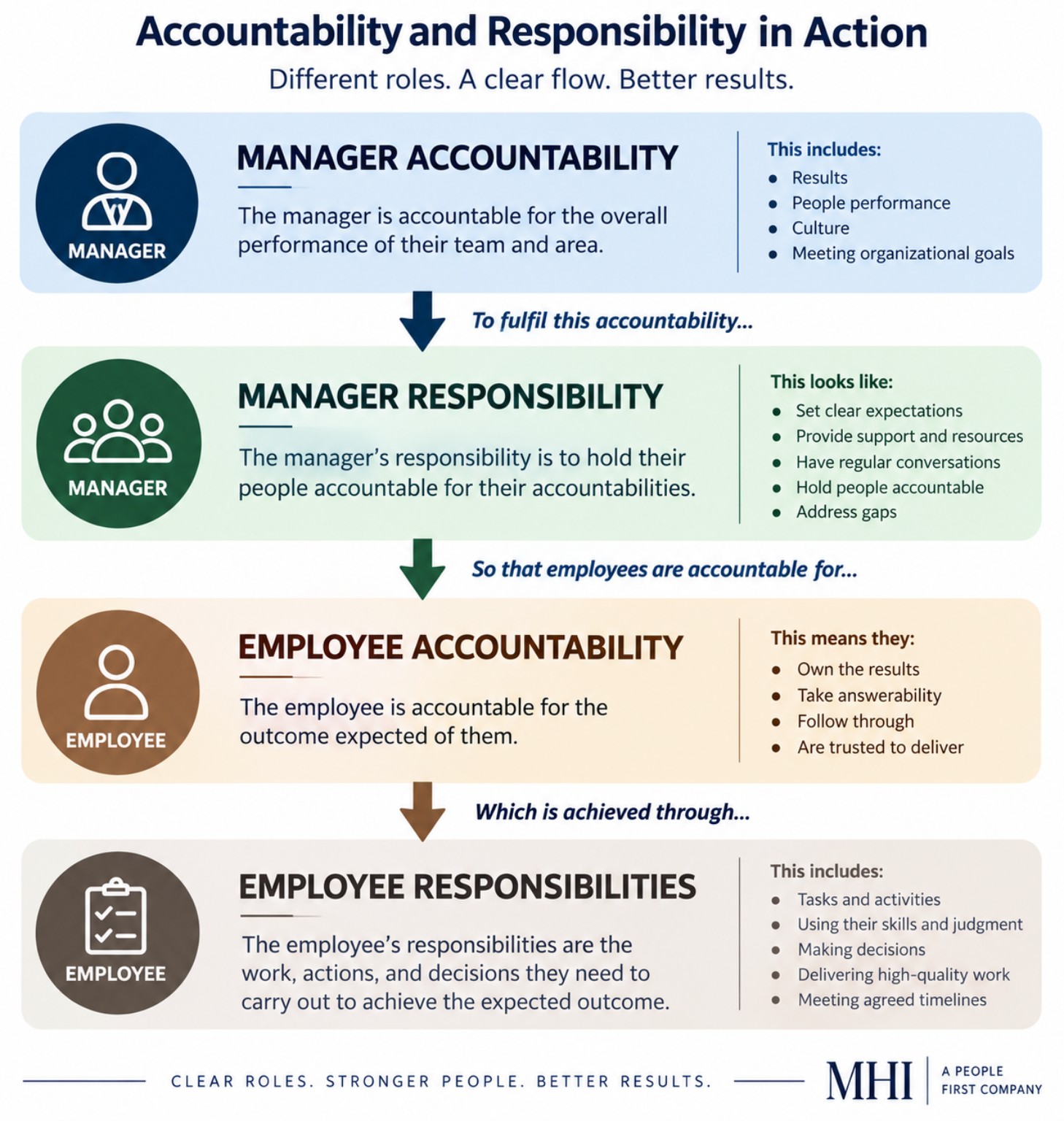
Responsibility is the work. It is the tasks, actions, decisions, and follow-through required by a role. It is preparing the report, speaking with the customer, completing the inspection, resolving the issue, or making sure an agreed milestone is met.
Accountability is ownership of the expected outcome. It means a person can say, “This is mine to see through.” They do not simply complete a list of tasks. They pay attention to whether the work is achieving what it is meant to achieve. If they need information, a decision, or support, they ask for it. If a risk appears, they raise it. If something has gone off course, they do not wait for someone else to discover it.
Employees need both clear responsibilities and clear accountability. They need to know what is expected of them, what decisions they can make, where to get help, and what successful work looks like. They also need to be trusted to do the work they own.
A manager’s accountability is broader. Managers are accountable for the results, people performance, culture, and organizational goals within their area. Their responsibility is to create the conditions that allow people to succeed: clear expectations, appropriate resources, regular conversations, useful feedback, and action when gaps appear.
This is not passive management. A manager who holds people accountable does not disappear and hope for the best. They pay attention to the work, ask good questions, recognize progress, address problems early, and make decisions when decisions are needed. In some situations, close oversight is appropriate. Someone may be learning, the risk may be high, or performance may have slipped. The issue is not the use of close management. The issue is treating every person and every task as though it requires the same degree of control.
When the relationship is understood, employees have greater clarity about what they own. Managers can focus on leadership rather than taking over the work. Everyone has a clearer understanding of what success requires.
Return to the gardeners. The head gardener does not need to water every plant to fulfill his accountability. He needs to ensure that every garden receives the care required to flourish.
Clear ownership. Meaningful support. A shared commitment to results.
Know what you own.