Lately, I have had several conversations about empathy and sympathy. The words are often used interchangeably, and a thesaurus may treat them as close relatives. They are related. They are not the same.
The distinction matters in the workplace.
People need to know that their manager cares. Not because work should become sentimental, but because people are far more likely to speak honestly, accept difficult feedback, ask for help, and stay engaged when they believe they are dealing with someone who sees them as a person.
Nobody cares how much you know until they know how much you care. It is an old line because it remains true.
Empathy is a thinking response. It says: I think I know how you’re feeling.
It does not mean agreeing. It does not mean excusing poor conduct. It does not mean assuming we know someone’s story. It means taking another person’s perspective and considering what they may be experiencing before deciding what it means.
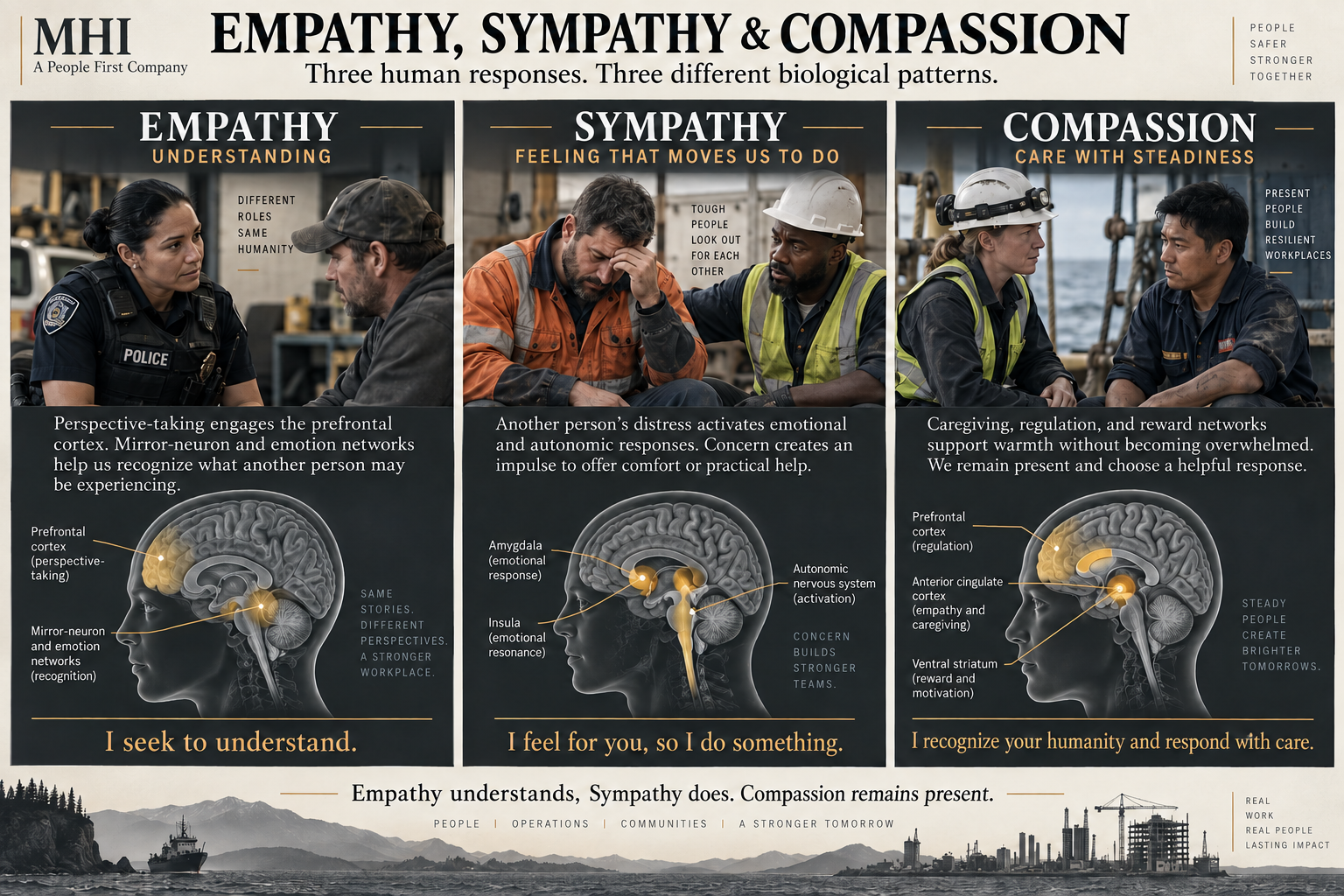
The image accompanying this article names the biological pattern simply. Empathy engages the prefrontal cortex, the part of the brain that supports perspective-taking. The activation of mirror-neuron and emotion networks helps us recognize what another person may be experiencing. Empathy gives us the capacity to pause, notice, and think beyond our immediate reaction.
Sympathy is different. Sympathy is what we feel when another person’s distress reaches us. We may feel badly for them. We may want to comfort them, protect them, fix the problem, or step in and do something.
That response can be generous and necessary. If someone is struggling, sympathy can move us to offer practical help. It is often the first expression of care.
But sympathy can also become reactive. When we are overwhelmed by another person’s pain, we may rush to make it go away, sometimes because their discomfort has become uncomfortable for us. We may solve too quickly, avoid the real conversation, lower a standard without considering the consequences, or take on work that belongs to someone else.
I feel for you, so I do something.
That is not wrong. It is simply not the same as understanding.
Then there is compassion.
Compassion carries empathy and sympathy forward, but it is steadier. Compassion recognizes another person’s humanity and responds with care, judgment, and responsibility. It does not require us to agree with someone, rescue them, or remove every consequence. It requires us to remain present.
I recognize your humanity and respond with care.
This is especially important for managers. A manager may need to address missed commitments, difficult behavior, conflict, or a performance concern. Compassion does not make those conversations disappear. It makes it possible to have them without reducing a person to their mistake.
A compassionate manager can say, “I can see this has been difficult,” and also say, “We still need to address what happened.” They can listen carefully without abandoning accountability. They can offer support without taking responsibility away from the person who needs to act.
That is where workplaces often get stuck. We confuse empathy with softness, sympathy with caring, and compassion with letting things slide. In reality, these are different human capacities, and strong leadership needs all three.
Empathy helps us think about what another person may be feeling and experiencing.
Sympathy helps us feel concern and offer support.
Compassion helps us respond in a way that honors both the person and the responsibility.
At MHI, we believe people are not resources to be managed. They are people to be understood. That belief does not lower the standard for work. It raises the standard for how we lead.
When people trust the process, they tell us what is true. When leaders listen with curiosity, humility, and respect, they are better able to see the real issue. And when care is joined with clarity and accountability, people and organizations are stronger for it.
Empathy thinks: I think I know how you’re feeling. Sympathy does. Compassion remains present.